
Residential School Memorial
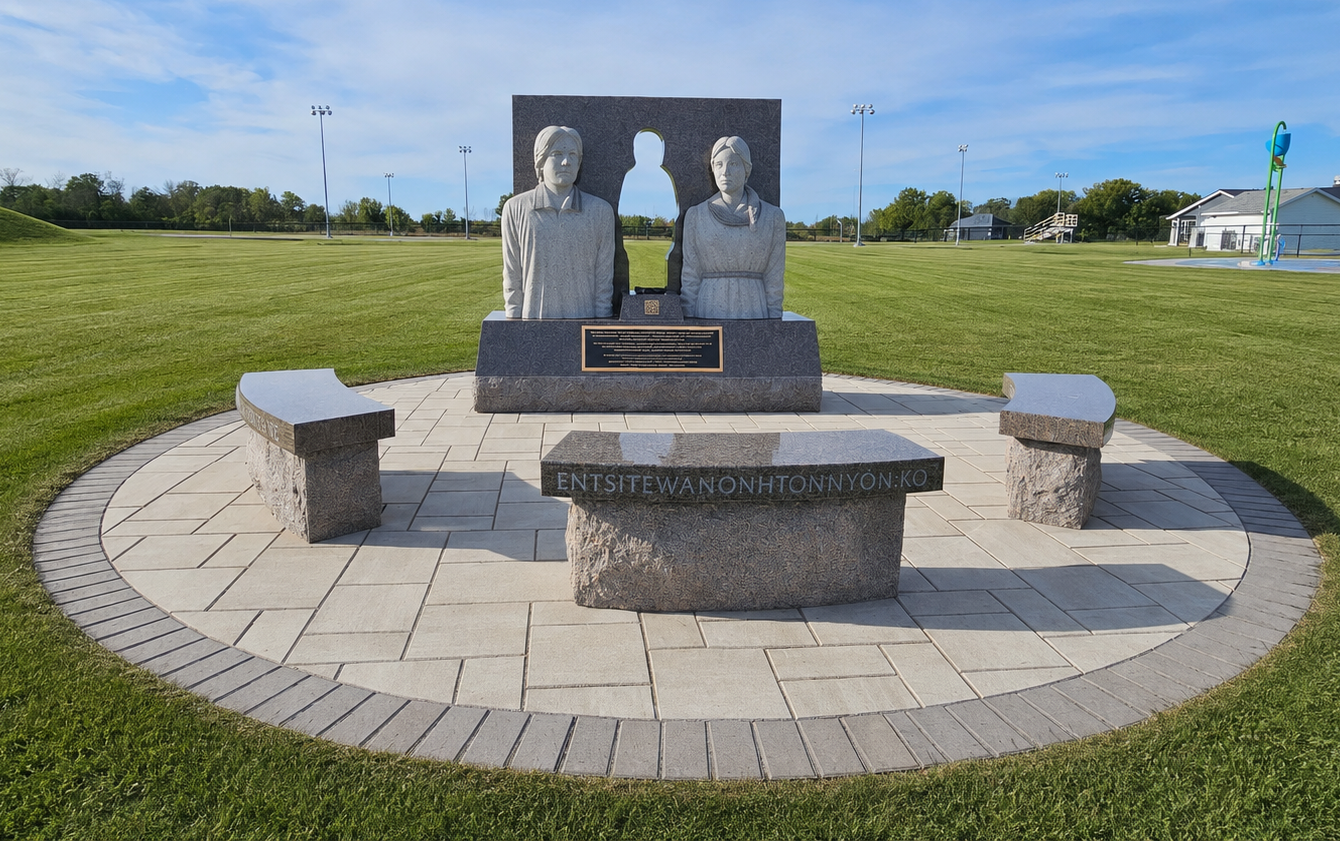
Entsitewehyà:ra’ne’
Remembrance
Entsitewanonhtonnyón:ko’
Reflection
Entsyonkwayén:ta’ne’
Reclamation
Ne ayethiyehyà:ra’ne’ tsi niká:yen wahonwatiwiráhkhwa’ táhnon a’é:ren wahonteweyenstà:na’ Residential School. Ne tayethinonhwerá:ton’ ne kahwá:tsire táhnon tsi nikanakeratsherò:ten teyotonhwentsyóhon karì:wes wahontehrhá:rate’.
Tayethinonhwerá:ton’ nahò:ten kanó:ron nayonkwayà:tawen’ne’ táhnon’ ò:ni aonthró:ri’ tsi niyonkwa’shatstenhserò:ten. Ne ken’ nón:we enwá:ton’ entsitewehyà:ra’ne’, entsitewanonhtonnyón:ko’, táhnon entsyonkwayén:ta’ne’.
In memory of the children who were removed from their homes and forced into Residential Schools.
To honour the families and communities left waiting in silence.
Acknowledging a painful part of our past yet standing as a symbol of healing and strength.
May this be a place of remembrance, reflection and reclamation.
Est. 2026
Creating the Moccasins
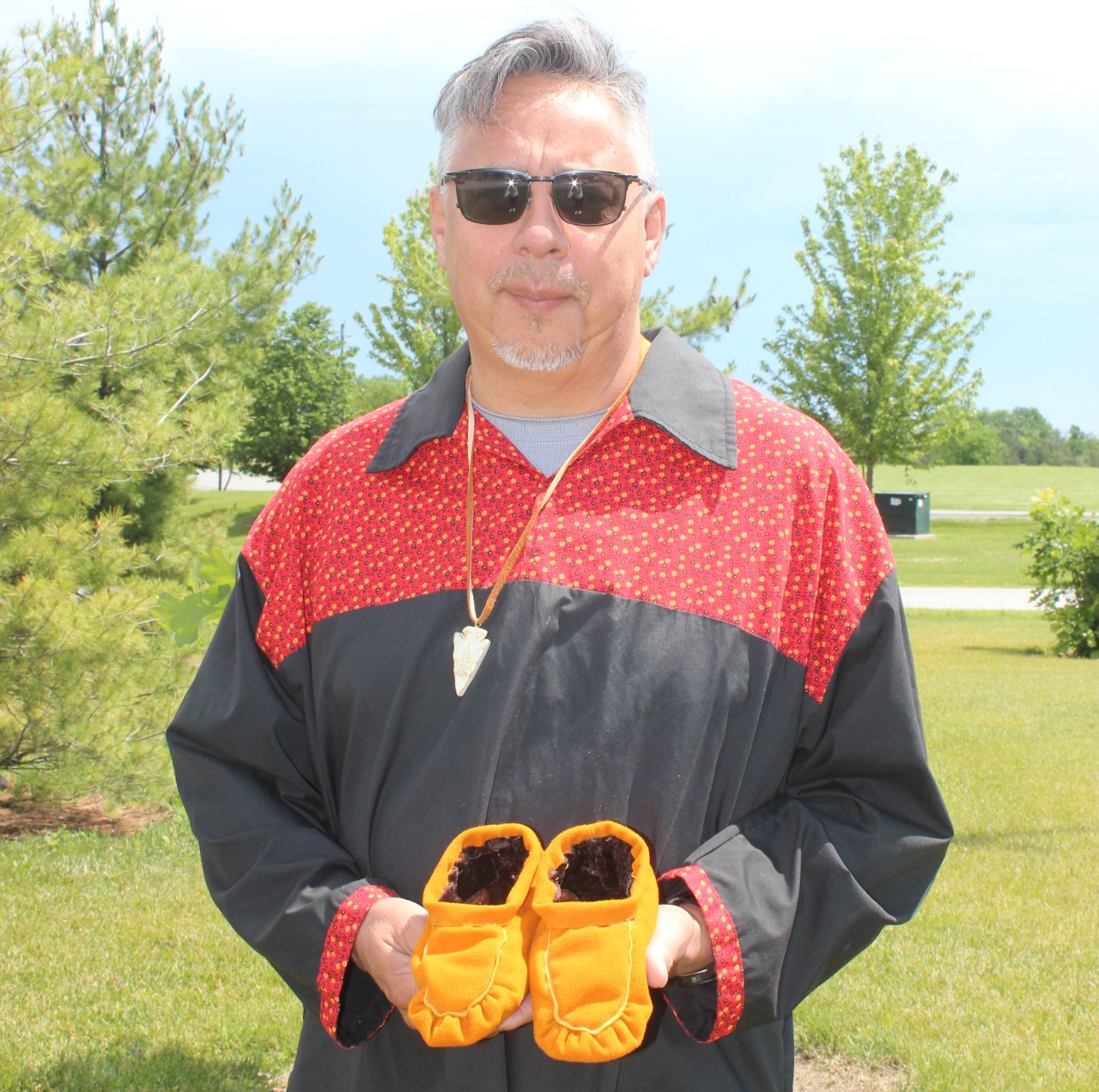
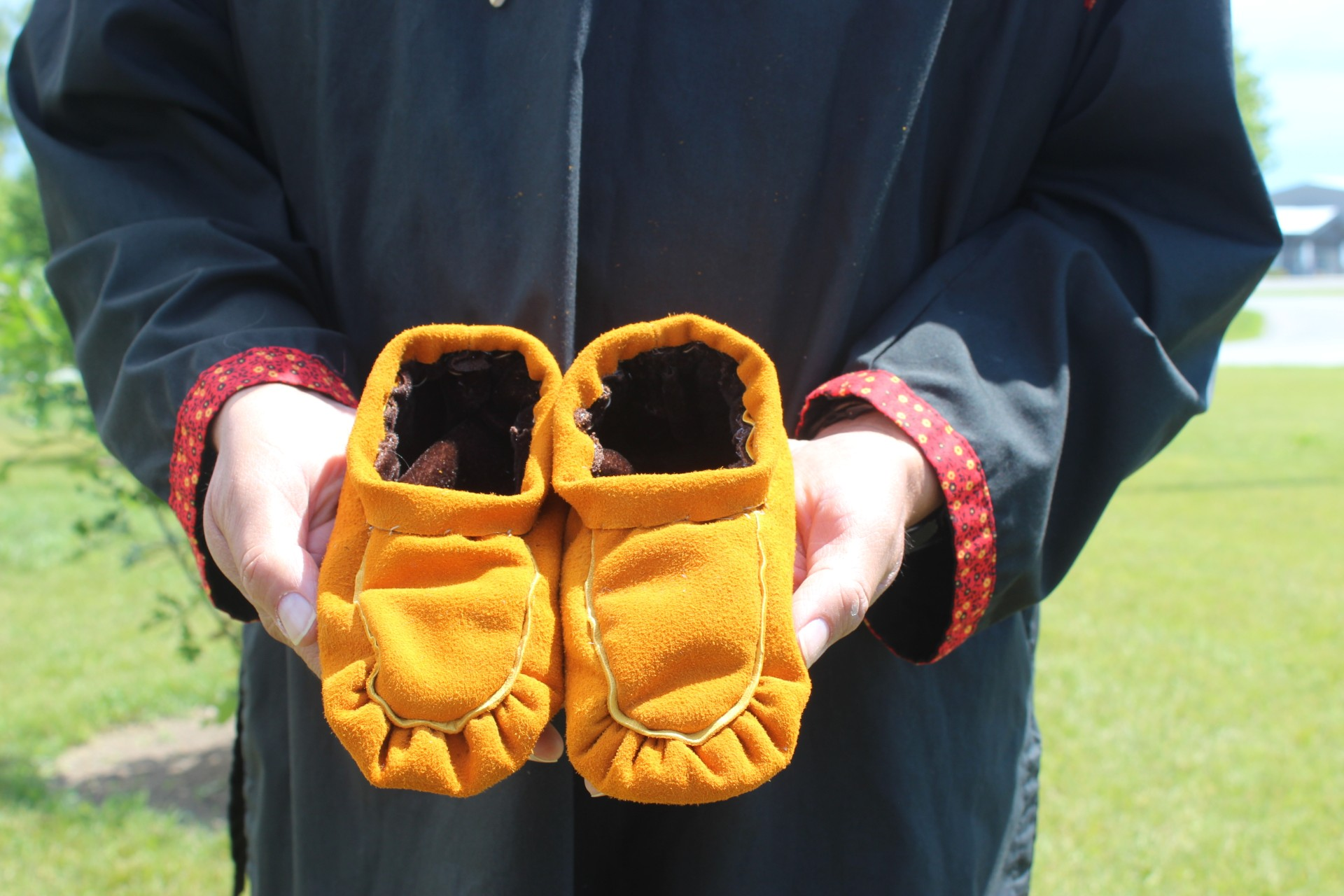
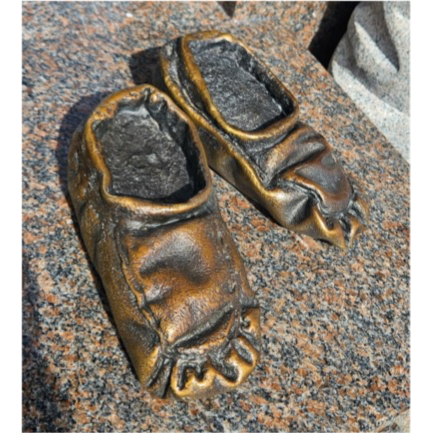
The moccasins were designed by Curtis Maracle. Once made they were cast in bronze and destroyed in the process.
“The origins of the moccasin manufacturing started with my oldest brother Kanatawakhon (David Maracle) in the late 1970s up until he left for university in 1982. He would provide our mother Joan (Sonhwentsyowane) Maracle with all the patterns for moccasins and mitts.
My moccasin making career began in the mid-1990s when my mother asked her children who would be interested in helping her. My mother and father would make the moccasins and travel to Pow Wows in Ontario and festivals in New York State. She used an industrial sewing machine to help her mass produce the moccasins for these events. My father Ken, would stretch the hides, mark with patterns and cut out the patterns with a pair of scissors. The first steps to this part of my life began with me learning how to use the patterns on the deer hide and not waste the hide. I spent several months at this and eventually graduating to the sewing machine where my mother taught me how to control the machine on a piece of paper and eventually, she trusted me enough to start sewing soles onto the foot and sewing the heels together while she sewed the vamps the foot.
The best part of this career wasn’t traveling to Pow Wows or festivals, it was spending time with my mother and talking about everything over tea and the sewing machine.”
-Curtis Maracle
From Vision to Stone: The Making of the Residential School Memorial
This piece was commissioned by Campbell Monument. We are grateful to the team at Campbell Monument for their dedication to learning and understanding the complex history of Residential Schools and the importance of this memorial to our community. Nyawen’kó:wa!
Click here to learn about the process of vision to stone.
 712 Dundas Street West, Belleville Ontario
613-966-5154
The Effects of the Residential School System on Kenhtè:ke
Learning the impact Residential School has had in Kenhtè:ke is a continuous, ongoing effort.
We are still learning about children of the community who were sent away to Residential School, and through record collection and personal stories, have begun to understand the depth of their effects on our community.
As of 2026, we know of 119 children from our community who were sent to the Mohawk Institute. These children attended approximately between the 1860s to the 1960s. The youngest child we know of so far was sent to the Mohawk Institute at just 5years of age.
We know of 21 children of the community who were sent to Shingwauk in Sault Ste Marie. They attended between 1889 and the 1950s. The youngest child we know of so far was sent to Shingwauk at just 6 years of age.
Reasons
There were various reasons why children were sent away to Residential School.
In some instances, especially in the 19th century, it was viewed as a way to get an education. It was a way to become a teacher or learn a trade such as carpentry or shoe-making.
Children were also sent away when officials such as the Missionary or the Indian Agent began to assert themselves as custodians of our people. Residential Schools were viewed as a way to manage children who had been orphaned or viewed as hard to manage. Residential School was also a way to separate children from parents who were not living a “good life”.
Lasting Effects
With Residential Schools being so far from our home community, and the systemic bans against cultural practices and speaking our language, there was an immense loss of identity, culture and language. Children were forced to adopt a new language and a new identity. Our culture, traditions, language and knowledge systems were eroded by forced assimilation.
Residential School also created a loss of family ties. Even if siblings attended the same school, brothers and sisters rarely saw each other. They also never saw healthy examples of love and respect.
Thousands suffered abuse – physical, sexual, psychological – at Residential School. Many who attended have never spoken about their time at the schools.
Those we lost
The Survivors’ Secretariat has documented 101 deaths during the operation of the Mohawk Institute. Three children from the Mohawks of the Bay of Quinte passed away at the Residential School.
Louisa Leween
Daughter of John & Annie (Brant) Leween.
Born 1892.
Went to the Mohawk Institute in 1901.
Died April 30, 1902
Buried Mohawk Chapel Cemetery
Jane ‘Jenny’ Maracle
Daughter of Peter & Sarah (Claus) Maracle
Born about 1885.
Died at 16 years of age, August 16, 1900 at the Mohawk Institute.
Buried August 16, 1900 at Mohawk Chapel Cemetery, Brantford
Margaret Maracle
Daughter of John H. & Elizabeth (Barnhart) Maracle
Born 1885.
Died June 16, 1901 at 14 years of age of meningitis
Buried at Mohawk Chapel Cemetery, Brantford
There were those who died shortly after returning from Residential School.
Edith Ann Claus
Daughter of Samuel & Ellen (Loft) Claus
Born 1894.
Admitted to the Mohawk Institute in 1908.
She returned home sometime before September 1910. She died September 17, 1910 from tuberculosis. Her death registration states she had suffered from TB for a year.
Ida Maracle
Daughter of Moses & Jenny (Williams) Maracle
Born in 1880.
Admitted to the Shingwauk School in 1890.
Ida came back to the community and married Milo Maracle in October 1896. Ida died before the Spring of 1897.
Anthony Maracle
Son of Moses & Jenny (Williams) Maracle
Born in 1883.
Attended Shingwauk from 1890 to 1907.
After returning to the community, Anthony volunteered to serve in WW1 in 1916 but was deemed medically unfit. He died in 1919.
There were many children who made the choice not to return to their home, as it was too difficult. Some were enfranchised, some lost their status through marriage, while others relocated.
Names of Mohawks of the Bay of Quinte members who attended the Mohawk Institute
Names of Mohawks of the Bay of Quinte members who attended Shingwauk
Additional Information
Woodland Culture Centre / (former) Mohawk Institute: Commonly referred to as the Mush Hole, this was the longest running Residential School operating from 1831 – 1970.
Shingwauk Residential School: Located in Sault. Ste. Marie on Robinson-Huron Territory, this institution operated from 1873-1970.
Orange Shirt Society: Founded by Phyllis Webstad, the Orange Shirt Day began in 2013 as a grass roots movement to bring awareness to Residential Schools, the children, and their families.
Truth and Reconciliation Commission of Canada: In 2015 the TRC released the report Truth and Reconciliation – 94 Calls to Action designed to “appeal to mobilize all levels of government, organizations, as well as individuals to make concrete changes in society.” This report can be found here: 94 Calls to Action.